First, find out how deep the scratch is
Car paint is built up in layers: primer on the metal, then the base coat that gives the colour, then a clear coat on top that gives the gloss. How you repair a scratch depends on which layer it reaches.
Wash and dry the area, then run a fingernail gently across the scratch, not along it.
- Your nail doesn't catch: the scratch is in the clear coat. It can almost always be polished out.
- Your nail catches slightly, but you still see colour in the groove: it is into the base coat. Polishing makes it much less visible; touch-up paint fills it.
- You see white, grey or bare metal: it is through to primer or metal. That needs touch-up paint at minimum, and a panel beater if it is long or the metal is showing, because exposed steel will rust.
A quick extra check: wet the scratch with water. If it nearly disappears while wet, it is shallow and in the clear coat.
Which fix suits which scratch
| Scratch type | Best fix | DIY? |
|---|---|---|
| Swirl marks and light wash scratches | Machine polish | Yes, with care |
| Single light scratch, nail doesn't catch | Hand or machine polish with a fine compound | Yes |
| Scuff with paint from another car or a pole | Clean off the transfer, then polish | Usually |
| Nail catches, colour still visible | Polish to soften, touch-up to fill | Possible, hard to make invisible |
| Through to primer or metal | Touch-up paint or a panel beater | Small chips only |
| Long key scratch across panels | Panel beater or paint shop | No |
How to polish out a light scratch at home
- Wash and dry the panel. Any grit left on the paint gets rubbed in and makes new scratches.
- Clay the area with a clay bar or clay mitt and lubricant, so the polish works on the paint, not on bonded grime.
- Mask off nearby plastic trim and rubber with low-tack tape. Compound stains black trim.
- Apply a small amount of scratch remover or fine compound to a foam applicator or machine pad.
- Work it in short, overlapping passes with light to moderate pressure, then wipe off with a clean microfibre and check in good light. Repeat two or three times at most.
- Follow with a finishing polish to bring back the gloss, because compound can leave a slight haze.
- Protect the area with wax, sealant or a ceramic spray. Polishing removes any old protection.
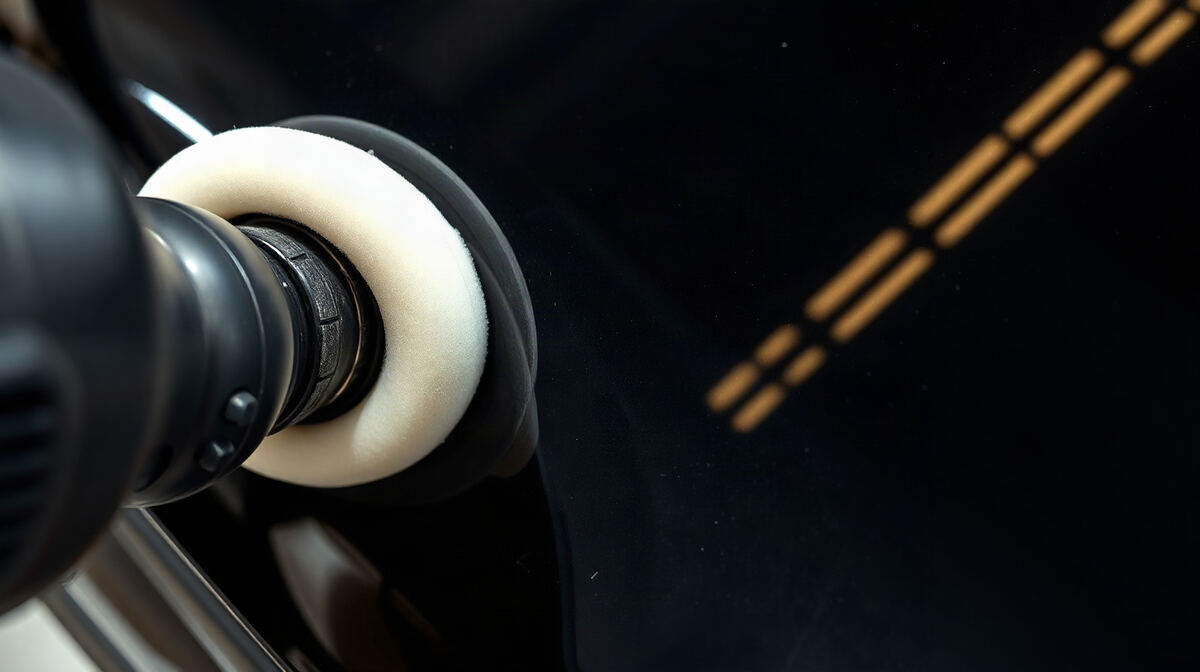
A dual-action machine polisher does this far faster and more evenly than hand rubbing. Our car polisher guide explains which machine and pads to use.
Touch-up paint for deeper scratches and chips
If the scratch shows primer or metal, polishing alone won't fix it. Touch-up paint, matched to the colour code on your car's compliance plate or door jamb sticker, fills the groove and seals the metal from rust. Apply it in thin layers with a fine brush or toothpick, letting each dry, and keep it inside the scratch. It hides a scratch well from a few steps back but rarely makes it invisible up close.
The car touch-up paint guide covers matching the colour and applying it neatly.
Mistakes that make scratches worse
- Toothpaste and magic erasers: they are abrasive in an uncontrolled way and leave dull, hazy patches.
- Sanding without experience: wet sanding removes clear coat fast. Go too far and the only fix is a respray.
- Polishing the same spot over and over: each pass takes off a little clear coat. Two or three passes is the limit for DIY.
- Working in direct sun: products dry on hot paint and smear or stain.
- Polishing near edges and body lines: paint is thinnest there and burns through first.
When to get scratches repaired professionally
A detailer is worth it when there are many scratches or swirl marks across the car, when you want the result to match the rest of the paint, or when the car is dark coloured, which shows every polishing mark. Detailers measure paint thickness, use machine polishers with the right pads and finish the job with protection.
Want it done for you? Get a fixed-price quote for car scratch repair and removal in Auckland. If the whole car has swirls, paint correction treats every panel at once.
Frequently asked questions
Can all car scratches be removed?
No. Scratches in the clear coat can usually be polished out completely. Scratches that catch your fingernail can only be reduced by polishing. Scratches through to primer or metal need touch-up paint or a panel beater.
How do I know if a scratch will polish out?
Run a fingernail across it. If your nail doesn't catch, or the scratch almost disappears when wet, it is in the clear coat and should polish out.
Does scratch remover actually work?
On light clear coat scratches and scuffs, yes. It is a fine abrasive polish that levels the clear coat around the scratch. It cannot fill a deep scratch.
Can toothpaste remove car scratches?
It isn't a good idea. Toothpaste is an uncontrolled abrasive and often leaves dull, hazy patches that need a proper polish to fix.
How much does car scratch repair cost?
It depends on how many scratches there are, how deep they go and the size of the area. A detailer can polish out light scratches for much less than a respray. Send a photo for a free, no-obligation quote.
Will a ceramic coating stop scratches?
It helps against light wash marks and makes the car easier to clean, but it will not stop keys, stones or branches. Paint protection film is the option for physical protection.