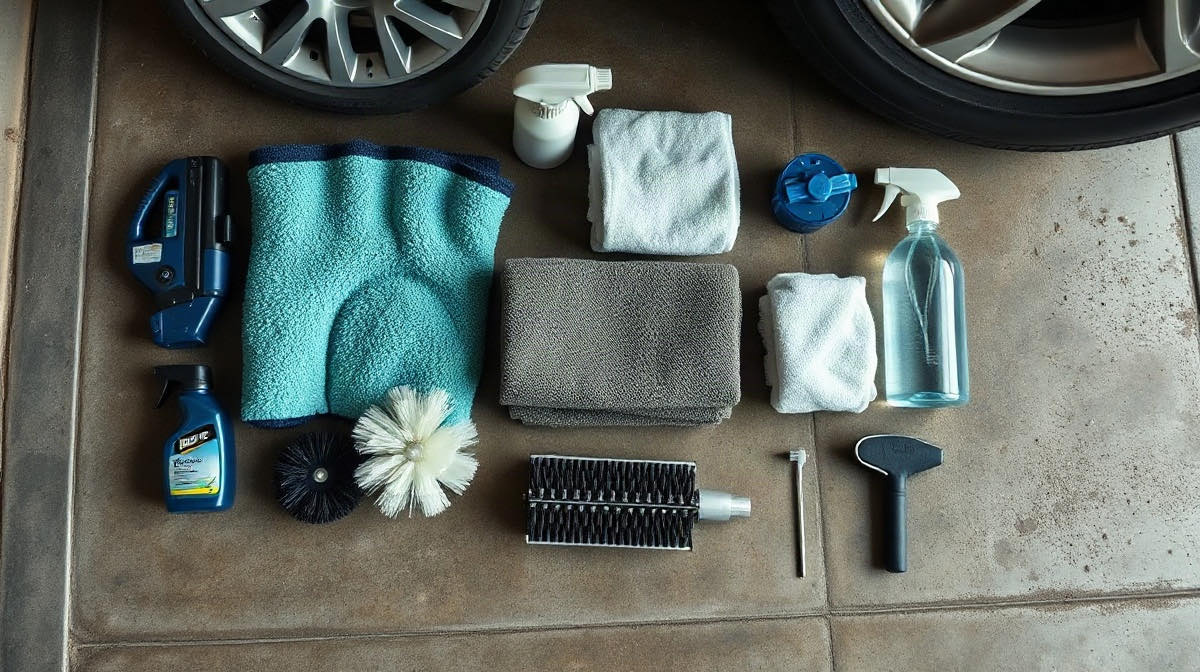
The short answer: match the brush to the surface
Use stiff brushes on tyres and carpets, soft or microfibre brushes on wheel faces and barrels, small soft detailing brushes on badges, grilles and vents, and soft leather or upholstery brushes on seats. Keep every brush off flat paint. A clean microfibre wash mitt is the safer tool for door panels, bonnet and roof, because a mitt holds grit inside its pile while bristles drag it across the clear coat.
The other rule that prevents most damage: brushes that have touched tyres or brake dust never go near paint or the interior. Brake dust contains hard metal particles, and a brush carries them wherever it goes next.
Types of car cleaning brushes at a glance
| Brush | Typical bristle | Use it on | Never use it on |
|---|---|---|---|
| Wheel face brush | Soft, flagged (split-tip) synthetic | Spokes, wheel face, around nuts | Paint, glass |
| Wheel barrel brush | Soft synthetic, foam or microfibre sock | Inside of the rim behind the spokes | Paint |
| Lug nut brush | Small round synthetic head | Wheel nut recesses | Paint |
| Tyre brush | Stiff nylon or polypropylene | Tyre sidewalls, mud flaps, rubber mats | Paint, wheels, leather, glass |
| Detailing brush | Boar hair or soft synthetic | Badges, grilles, trim gaps, vents, buttons | Heavy dirt on paint panels |
| Carpet brush | Stiff synthetic, often drill-mounted | Carpets, floor mats | Leather, Alcantara, paint |
| Leather or upholstery brush | Soft horsehair or soft synthetic | Leather, vinyl, fabric seats | Tyres or wheels (keep it interior only) |
Wheel, barrel, lug nut and tyre brushes
Wheel face brushes have a broad head of soft bristles for the front of the wheel and the spaces between spokes. Meguiar's describes its Wheel Face Brush as having soft, feathered bristles and a rubber bumper to stop the head knocking against the rim edge. That bumper matters on painted and diamond-cut wheels, where a hard plastic head can chip the finish.
Barrel brushes are long and narrow so they reach the inner rim, where most brake dust sits. Some use bristles, others a foam or microfibre head. Bowden's Own says its Flat Head brush is metal free, uses a removable, washable microfibre sock and has a tapered head for the gap around brake calipers. Metal-free construction is worth checking for on any wheel brush, because an exposed wire core will scratch a rim.
Lug nut brushes are small round brushes that twist into the nut recesses, where a mitt can't reach and dust collects. Tyre brushes are the stiffest brushes you'll own. They scrub old dressing and browning off the rubber so a new dressing sticks evenly. Use them on the tyre only, not on the wheel lip next to it.
Detailing brushes: boar hair vs synthetic
Detailing brushes are the small paintbrush-style tools for badges, emblems, grilles, window seals, fuel caps, vents and the seams around switches. They come in two main types:
- Boar hair is a natural bristle that softens when wet. It's the traditional choice around badges and emblems because it agitates dirt without much force. Natural bristles shed a little when new and need to dry fully between uses, or they can go musty.
- Synthetic bristles (nylon, polyester, or flagged-tip plastics) are more consistent, cope better with strong cleaners, and dry faster. Soft synthetic brushes with flagged tips are close to boar hair in feel; firmer ones suit textured plastics and tyre lettering.
Either type works inside the car. For vents and screens, a very soft brush or a dedicated vent brush avoids scratching gloss-black trim, which marks easily. Pick brushes with a plastic or rubber-covered ferrule (the band holding the bristles) so the metal can't touch the surface.
Interior brushes: carpet, upholstery and leather
Carpet brushes are stiff and are often sold as drill attachments. They lift matted pile and work cleaner into floor mats. Keep them off seats: the same stiffness that helps on carpet can fuzz fabric and scuff leather.
Upholstery and leather brushes are soft, usually horsehair or fine synthetic. On leather, the brush works a foam cleaner into the grain and seams, then a microfibre cloth lifts the dirty foam away. Go gently on perforated leather, as bristles can push cleaner into the holes, and on Alcantara and suede-style fabrics, where Alcantara notes that dust and grit trapped in the material can damage the surface. Our car seat cleaner guide covers the cleaners that go with these brushes.
Which brushes are safe on paint (and which never are)
No brush is as safe on flat paint as a clean wash mitt used with the two-bucket method. A soft boar hair or flagged synthetic detailing brush is acceptable on painted areas only where a mitt can't fit, such as around badges, inside grilles and along panel gaps, and only with plenty of soapy water or foam as lubrication.
Never use these on paint:
- Tyre brushes and any stiff nylon or polypropylene brush.
- Drill brushes of any stiffness.
- Wire, brass or household scrubbing brushes, including dish brushes and brooms.
- Any brush that has already been used on wheels or tyres.
- Long-handled wash brushes on dark or soft paint. They're quick for vans, trailers and caravans, but they will add fine swirl marks to a car's clear coat over time.
If the paint already shows swirls from brushes or automatic washes, that is a polishing job, covered in our paint correction cost guide.
How to use car cleaning brushes properly
- Wheels first, with a separate bucket. Rinse the wheel, spray wheel cleaner on a cool wheel, then brush the barrel, face and nuts before the cleaner dries.
- Keep everything wet. A dry brush on a dry surface scratches. Dip it often and let the product do the work.
- Light pressure. Let the bristle tips flick dirt out of a gap. Pressing hard bends the bristles flat and puts the ferrule against the surface.
- Rinse the brush between areas so grit from one wheel isn't carried to the next.
- Inside the car, spray the brush, not the surface, near screens, switches and electronics, so liquid doesn't run into them.
- Follow with microfibre. Brushes loosen dirt; a cloth or rinse removes it.
How to clean and store your brushes
Dirty brushes are the main way grit gets back onto a car. After each wash:
- Rinse each brush under a strong stream of water, working the bristles with your fingers until the water runs clear.
- For greasy or brake-dust-loaded brushes, soak briefly in a bucket of warm water with car shampoo or a diluted all-purpose cleaner, then rinse again.
- Shake out excess water and dry with the bristles pointing down or the brush lying flat, so water doesn't sit in the handle or ferrule. Natural bristles in particular need to dry fully before storage.
- Store wheel and tyre brushes in a separate bucket or bag from paint and interior tools.
- Replace a brush when the bristles splay permanently, the tips go hard, or a microfibre sock is worn through.
A sensible starter set, and what it costs in NZ
Most people only need five brushes: a soft wheel face brush, a barrel brush, a stiff tyre brush, a small set of soft detailing brushes, and a carpet brush. Add a leather brush if you have leather seats. Selection criteria matter more than brand: metal-free construction on anything that touches wheels, soft or flagged tips on anything near paint or trim, and handles long enough to keep your knuckles off the rim.
At the time of writing (November 2026), Supercheap Auto NZ lists detailing brush sets from $11.99 (SCA Detailers Brush 3 Piece) to around $40 (Meguiar's Different Strokes 3 pack at $39.99, Bowden's Own The Foursome 4 piece at $40.99), and a Chemical Guys Nice & Stiff carpet and interior brush at $17. Its wheel brush range runs from $11.49 (ToolPRO Nylon Filament Wheel Brush) and $13.99 (SCA Double Loop) up to $36.99 for the Bowden's Own Flat Head and $109.99 for a three-piece Chemical Guys wheel set.
Bunnings NZ lists an All Set 3 Piece Car Care Detail Brush Set at $11.50, an All Set Long Head Wheel Brush at $16.98, a Turtle Wax Jumbo Plush Wheel Brush at $26.98 and a Mothers Total Care Detailing Brush Set at $38.36. Prices change often, so check the retailer before you buy. For the rest of the kit, see the car cleaning kit guide.
When to use a professional
Brushes handle routine wheel and trim cleaning well. A professional is worth it when brake dust has baked onto the wheels and needs iron removers and decontamination, when the interior needs hot-water extraction rather than brushing, or when years of brushes and automatic washes have left swirl marks that need machine polishing. Detailers carry separate, clean brush sets for wheels, paint and interior, which is hard to keep up at home. Or let us do it: get a quote for a full inside-and-out car clean in Auckland.
Frequently asked questions
Can I use a brush to wash my car's paint?
Only in tight areas such as badges, grilles and panel gaps, with a soft boar hair or flagged synthetic brush and plenty of soapy water. For flat panels a clean microfibre wash mitt is safer, because bristles drag grit across the clear coat.
What is the difference between boar hair and synthetic detailing brushes?
Boar hair is a natural bristle that softens when wet and is gentle around badges and emblems, but it needs to dry fully between uses. Synthetic bristles are more consistent, dry faster and cope better with strong cleaners.
Can I use the same brush on wheels and paint?
No. Brake dust contains hard metal particles that stay in the bristles and will scratch paint. Keep wheel and tyre brushes in a separate bucket and never use them anywhere else.
Are drill brushes safe on car seats?
Stiff drill brushes suit carpets and rubber floor mats. On fabric seats use a soft brush attachment with light pressure, and avoid drill brushes on leather, Alcantara and perforated seats.
How often should I replace car cleaning brushes?
Replace a brush when its bristles splay permanently, the tips go hard, it holds grit you can't rinse out, or a microfibre sock wears through. Cleaning and drying brushes after every use makes them last much longer.
Do I need a lug nut brush?
If your wheels have deep nut recesses, yes. A small round brush cleans them in seconds, and those recesses otherwise hold brake dust that runs back onto the wheel face after every wash.